
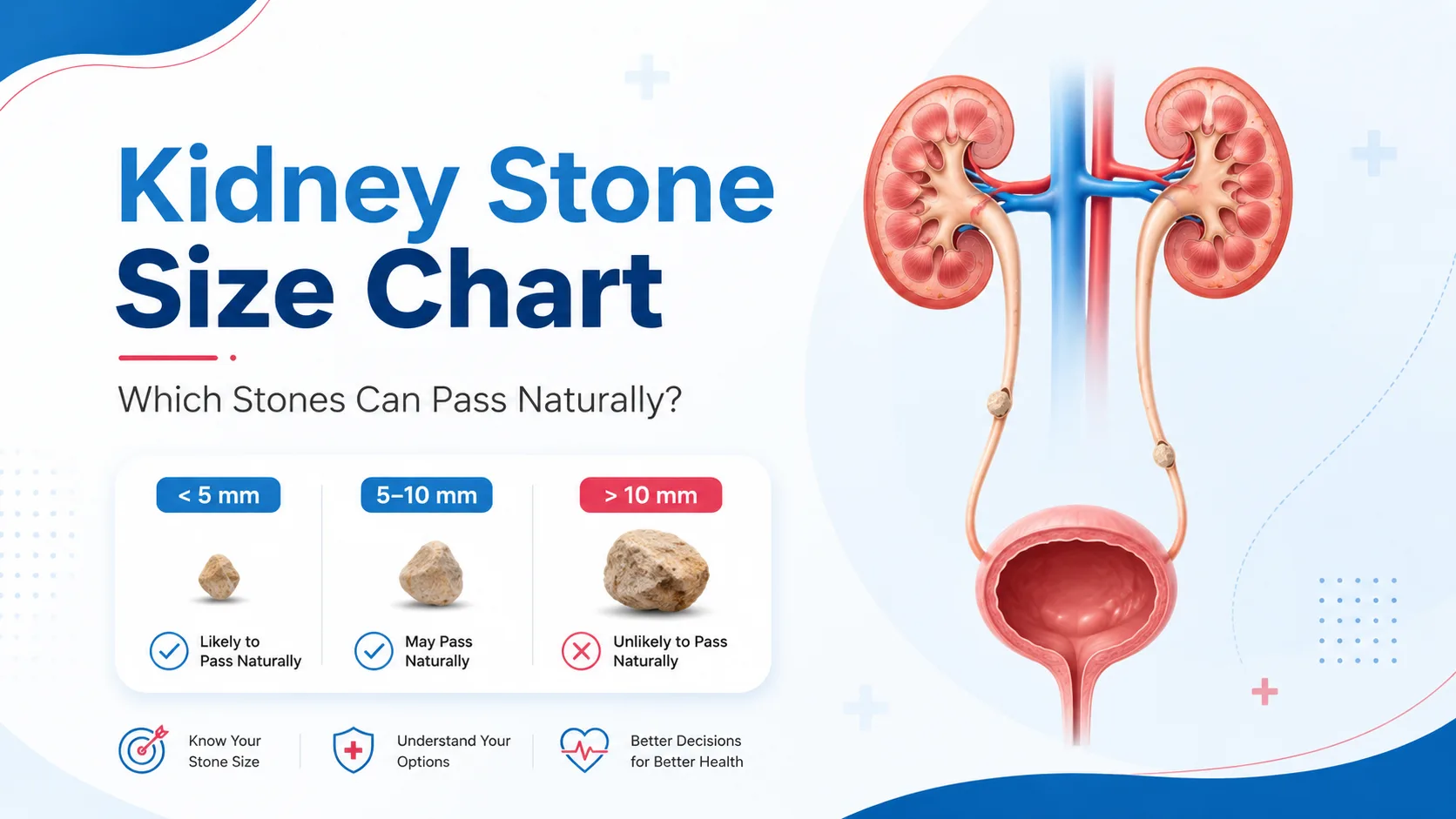
Kidney stones can be very painful, but not every stone needs surgery. One of the first things doctors look at is the size of the stone. Size can help estimate whether a stone may pass naturally through urine or whether treatment may be needed. However, size is not the only factor. The location of the stone, blockage, pain, infection and kidney function also matter.
This kidney stone size chart gives a simple guide, but the final treatment decision should always be based on a medical assessment.
What Does Kidney Stone Size Mean?
Kidney stone size is usually measured in millimetres, or mm, on an ultrasound or CT scan. A stone may remain inside the kidney without causing any symptoms. Problems often begin when the stone moves into the ureter, the narrow tube that carries urine from the kidney to the bladder. The ureter is much narrower than the kidney, so a stone may become stuck there and cause severe pain.
The exact measurement on the scan is important because a 3 mm stone and a 12 mm stone may have very different chances of passing. Doctors also look at where the stone is located. A smaller stone near the bladder usually has a better chance of passing than a similar-sized stone high in the ureter.
Kidney Stone Size Chart
| Kidney Stone Size | Chance of Passing Naturally | What It May Mean |
|---|---|---|
| Less than 5 mm | Often possible | Many small stones may pass on their own, especially when lower in the ureter. |
| 5–10 mm | Possible but less predictable | Some pass naturally, while others become stuck and need treatment. |
| 10–20 mm | Less likely | Specialist evaluation is usually needed. |
| More than 20 mm | Unlikely | A procedure is commonly considered depending on location and symptoms. |
This kidney stone size chart is a general guide. No size can guarantee that a stone will or will not pass. A small stone may still need treatment if there is infection or severe blockage.
Can a 5 mm Kidney Stone Pass Naturally?
A 5 mm kidney stone may pass naturally, especially if it has already moved lower in the ureter. Doctors may recommend observation when pain can be controlled, there is no infection, kidney function is stable and urine can flow properly. Medicines may sometimes be prescribed to help manage pain or help the ureter relax. Follow-up is important because the doctor needs to confirm that the stone has actually passed or moved.
Patients who have been diagnosed with a stone can learn more about kidney stone treatment at Kapadia Hospital, including evaluation and treatment options for stones that do not pass naturally.
Can a 6 mm to 10 mm Kidney Stone Pass?
Some kidney stones between 6 mm and 10 mm can pass, but the chance becomes lower as the stone gets larger. A stone in this range may remain stuck in the ureter and cause repeated attacks of pain. The doctor will usually consider the exact location, whether the kidney is swollen, whether urine flow is blocked, how severe the pain is and whether an infection is present.
If a stone is not moving, symptoms are continuing or there is significant obstruction, waiting may no longer be the safest approach. A urologist may then discuss procedures that can break or remove the stone.
What About Kidney Stones Larger Than 10 mm?
Stones larger than 10 mm are less likely to pass naturally through the ureter. Treatment depends on the size, location, number and hardness of the stones. Options may include shock wave treatment, ureteroscopy with laser fragmentation or other minimally invasive procedures. Large stones inside the kidney may sometimes need a procedure such as PCNL, which allows the surgeon to reach the stone through a small opening in the back.
The urology department at Kapadia Hospital evaluates kidney stones along with other urinary tract conditions and can recommend treatment based on scan findings and symptoms.
How Long Can a Kidney Stone Take to Pass?
Small ureteric stones may pass within days, while others can take a few weeks. Patients should still have follow-up because pain may improve even when a stone remains stuck. Repeat imaging may be needed to confirm that the stone has passed and the kidney is draining normally.
What Factors Affect Natural Kidney Stone Passage?
1. Stone Location
Stones closer to the bladder generally have a better chance of passing than stones high in the ureter. Location can be just as important as size.
2. Stone Shape
Smooth stones may move more easily than irregular stones. A rough or unusually shaped stone may get caught even when its measurement is not very large.
3. Swelling or Narrowing
If the ureter is narrow, inflamed or swollen, a stone can be more difficult to pass. Previous surgery or natural narrowing may also affect movement.
4. Infection
A urinary infection together with an obstructing kidney stone can become serious. Fever, chills or feeling very unwell with stone pain requires prompt medical attention.
5. Kidney Function
Doctors also check whether the blockage is affecting kidney function. If the kidney is under pressure for too long, active treatment may be needed even if the stone itself is not very large.
When Should You Not Wait for a Kidney Stone to Pass?
Medical attention is important if kidney stone pain is severe or keeps returning. Urgent assessment may be needed when there is fever, chills, repeated vomiting, difficulty passing urine, worsening pain, weakness or dehydration. A blocked urinary system together with infection can become an emergency and should not be ignored.
How Are Kidney Stones Diagnosed?
Doctors may use urine tests, blood tests, ultrasound or a CT scan. Imaging helps show the exact kidney stone size, its location and whether it is blocking urine. This information helps the doctor decide whether observation is reasonable or whether treatment should be discussed.
What Happens If the Stone Does Not Pass?
If the stone does not pass naturally, treatment is selected according to the individual case. Ureteroscopy uses a thin instrument passed through the urinary tract to reach the stone, and a laser can be used to break it into smaller pieces. Shock wave treatment may be suitable for certain stones. PCNL may be recommended for larger or more complex kidney stones.
The aim is not only to remove the stone. Treatment also helps relieve blockage, protect kidney function, control pain and reduce the risk of infection.
Can Water Help Pass a Kidney Stone?
Good hydration supports kidney health and may help some small stones pass. Excessive water will not force out a blocked stone and may increase discomfort. Patients should follow their doctor's fluid advice.
How Can Future Kidney Stones Be Prevented?
Prevention usually includes enough water and reducing excess salt. The exact diet can depend on the stone type. A passed or removed stone may be analysed, and blood or urine tests can help identify why stones are forming repeatedly.
When Should You See a Urologist?
A urologist should be consulted if there is severe side or back pain, blood in the urine, repeated stones, difficulty passing urine or a scan showing a stone that is not moving. Early assessment is also useful when a patient has only one functioning kidney or has previously had complications from kidney stones.
Frequently Asked Questions
Can a 4 mm kidney stone pass naturally?
Many 4 mm ureteral stones can pass naturally, especially when they are closer to the bladder. Follow-up is still important to make sure the stone has passed.
Does every 8 mm kidney stone need surgery?
No. Some 8 mm stones may pass, while others require treatment. The decision depends on location, blockage, pain, infection and other factors.
Is kidney stone size the only reason for surgery?
No. Infection, kidney function, persistent blockage, symptoms and stone location are also important when deciding treatment.
This article is for general awareness only. It does not replace a consultation, examination, diagnosis or treatment by a qualified doctor.